Use cases

Module-agnostic
by design.

Lens is not an HCM tool, not a Finance tool, not a Logistics tool. It is a conversational layer that learns whichever part of SAP you point it at — through a one-time metadata onboarding per module.

How a module comes online

One onboarding,
then conversation.

Every module Lens supports goes through the same short setup. Once it is done, business users simply talk to that part of SAP. No further development is required to ask new questions inside the same scope.

Identify the objects

Pick the SAP objects that matter for the questions you want to answer — typically a focused list, not the whole module.

Register the meaning

Capture business descriptions, relationships, and sensitivity flags. Lens does most of the lifting; an expert reviews and signs off.

Publish to users

Roles are granted access to the new scope. From that moment on, the module is conversational — alongside any others already onboarded.

The catalogue is incremental and reversible. New objects can be added later, descriptions can be refined, sensitivity can be tightened — without re-onboarding the rest.

Showcase · SAP HCM

What it looks like
in practice.

You decide which modules and which questions matter. Lens is built around fast metadata seeding and short iteration cycles, so a new area of your SAP estate goes from “not covered” to “answering questions in conversation” in days, not quarters. The examples below come from a SAP HCM deployment — treat them as a shape, not a ceiling.

Headcount & demographics

Live counts by location, department, contract type, age band — answered in conversation, not in a Friday ticket queue.

Operational lists

Birthday lists, jubilee lists, contract-end watchlists — produced on demand, scoped to the requester's authorisations.

Pay-element exploration

Browse who received which pay element, in which period, without writing a custom report or waiting for one.

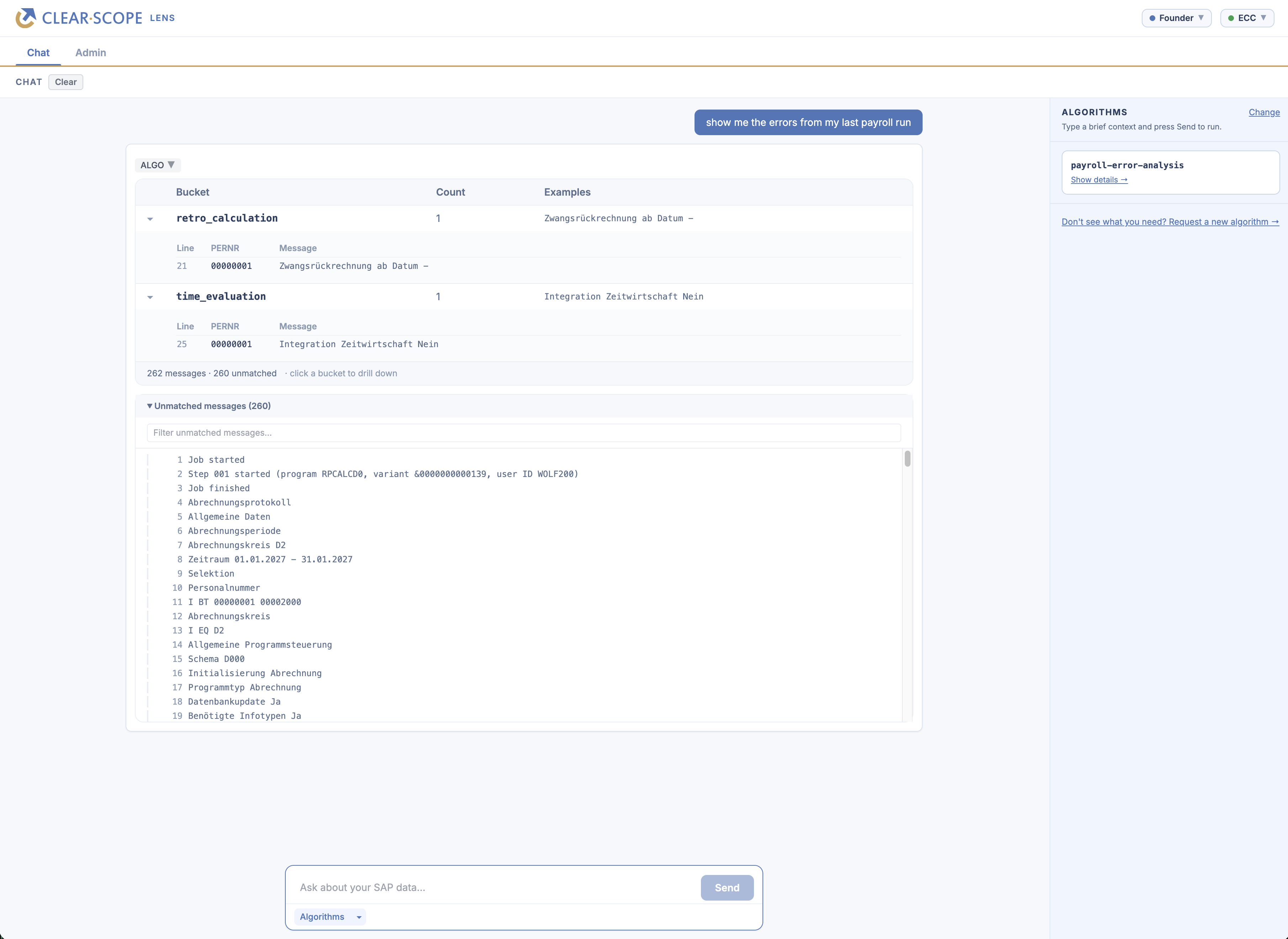
Payroll error analysis result — errors grouped into named buckets with examples and an unmatched-messages drill-down
Payroll-run errors grouped into named buckets, with PERNR-level drill-down and a filterable list of unmatched messages for follow-up.

Designed to extend

Same engine.
Any module.

Because the intelligence lives in the metadata catalogue — not in hard-coded module logic — onboarding a new area of SAP is a configuration project, not a software project. Customer demand drives the order; the engineering work does not change.

Finance (FI / CO)

Open items, ageing, posting investigations, cost-centre lookups — all the explorations that today live in spreadsheets.

Materials (MM)

Vendor lookups, stock positions, purchase-order traceability — answered without learning the field codes.

Sales & distribution (SD)

Customer order history, delivery status, returns — surfaced through the same conversational interface.

Cross-module questions

The same conversation can pull from more than one module when the question requires it — provided each is registered and authorised.

Custom & industry add-ons

Customer-specific Z-tables and industry solutions onboard the same way as standard modules — they are simply more entries in the catalogue.

Your module next

If the questions your team asks every week live in a module not listed above, that is exactly the kind of pilot we look for.

Who benefits

One product,
three audiences.

Business users

Get answers in seconds without learning SAP transactions or filing tickets. The conversation is the interface; the result is a chart, a table, or a number.

  • No SAP training required
  • Always scoped to what the user is allowed to see
  • Personal session history

SAP support & key users

Skip the round-trips for "can you check…" requests. Use Lens as a live introspection tool while triaging.

  • Schema lookup on demand
  • One-click reproducible analyses
  • Direct visibility into what the user actually asked

IT & compliance

Operate one well-bounded service instead of maintaining dozens of custom reports. Demonstrate control: every question, every result, every algorithm version is on record.

  • Centralised audit trail
  • Read-only by construction
  • Deployable on customer-controlled hardware
  • Algorithm risk profiles visible per run
Roll-out typically starts with a single SAP system and one user group. Expansion is incremental — module by module, role by role — without re-architecting.

Have a use case in mind?

Tell us the question your team can't answer fast enough today.

Start the conversation